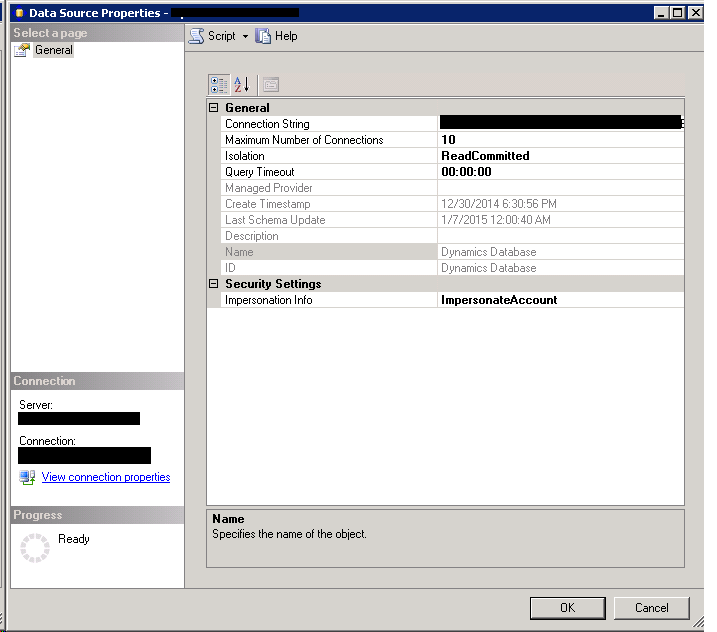
Just resolved a basic error with my functional team mate Qamar Zaman Khan. We both were online, Qamar for reproducing the error. Basically our cube processing was failing with the error, 

OLE DB or ODBC error: Login failed for user 'Domain\UserName$'.; 28000

I checked the cube and it had the wrong impersonation settings. I googled and found the issue hence echoing the same to all :D

http://stackoverflow.com/questions/18702987/olede-error-login-failed-for-user-domain-computername-28000  

In my case, the sql server analysis service login account was set local account which I think is not a good practice. And as default, the impersonation account is set to service account. Due to this, the impersonation was not working since local account (rendered as Domain\) did not had the required accounts on sql as a login. I provided a sql domain account and the error dissappeared :D. Snapshots for your reference


Enterprise Portal Development Videos

maqk® by Maqk | 3:05 PM

I have just started EP development - and I never knew it was all the same - just that proxies adds minor of complexity

And guess what - all my web dev xp is gonna get polished back

EP comes with some very powerful and ready to use web parts. This post is however a 'LINKS' and not 'TUTORIAL' post, the latter will come by next year since every1 is going for holidays. 

So without any delay, here they are, all videos, enjoy:

  • How do I videos - Enterprise Portal Development Series: 
    http://msdn.microsoft.com/en-us/dynamics/ax/cc507280.aspx
  • Videos at CustomerSource
    • Creating simple Enterprise Portal Lookups using EDT, DataSetField and custom lookups using DataSet or User Controls in Microsoft Dynamics AX 2012: http://mediadl.microsoft.com/mediadl/www/d/dynamics/customersource/CCAX2012HT0030_Enterprise%20Portal%20Lookup.wmv
    • Understanding record context when interacting with data in the Enterprise Portal for Microsoft Dynamics AX 2012: http://mediadl.microsoft.com/mediadl/www/d/dynamics/customersource/CCAX2012HT0029_Enterprise%20Portal%20Record%20Context.wmv
    • List page development in the Microsoft Dynamics AX 2012 Enterprise Portal: http://mediadl.microsoft.com/mediadl/www/d/dynamics/customersource/CCAX2012HT0031_Enterprise%20Portal%20List%20Page%20Development.wmv
    • Detail page development in the Microsoft Dynamics AX 2012 Enterprise Portal: http://mediadl.microsoft.com/mediadl/www/d/dynamics/customersource/AX2012CoreConceptsVideo_CCAX2012HT0032_EPDetailsPagesDev.wmv
    • Developing detail page interactions with Microsoft Dynamics AX 2012 Enterprise Portal, Part1: http://mediadl.microsoft.com/mediadl/www/d/dynamics/customersource/nCCAX2012DI0015_1_Enterprise%20Portal%20Details%20Page%20Interaction%20Patterns%20-%20Part%201.wmv
    • Developing detail page interactions with Microsoft Dynamics AX 2012 Enterprise Portal, Part2: http://mediadl.microsoft.com/mediadl/www/d/dynamics/customersource/CCAX2012DI0015_2_Enterprise%20Portal%20Details%20Page%20Interaction%20Patterns%20-%20Part%202.wmv
    • Debugging customizations and new development with the Enterprise Portal for Microsoft Dynamics AX 2012: http://mediadl.microsoft.com/mediadl/www/d/dynamics/customersource/CCAX2012HT0028_Enterprise%20Portal%20Debugging.wmv


X++ - Cancelling the event / method in its Pre event handler

maqk® by Maqk | 4:44 PM

Eventing enables to extend applications as well to decouple the components and underlying implementations. It is a great way to write new logic without worrying a change in the underlying components.

Automatic Event Handlers

X++ provides custom delegates as well as Automatic event handlers
  • Pre - Occurs before
  • Post - Occurs after

Pre Event Handler

One of the responsibilities / usage of the Pre event handler is to validate if all conditions are correct for the commencement of the main method. Or to populate / fill any other component(s) which is required in the main method.

Cancel Event

This became a pain for me last night. I was trying to do something that we does in DotNet windows application :D 

e.Cancel = true;

Where is that ? Answer is, perhaps no where :P (educate me if I am wrong please)

But there are alternates to it. Thanks to my ex colleague and friend Asim Saeed's blog post: Yes it is quite a natural alternate, simply throw an exception.

Problem

But that will end the whole program execution, unless caught in any catch and taken care there. What I mean is, consider a complex logic that spans multiple classes or methods. What if one of the optional method's Pre event handler simply throw's exception whereas the process should have continued. In such case, that particular event should be cancelled rather than the whole program flow. I want to have granular control here, only cancel the specfic event producer method, not the whole process 

One way to do this is to have a flag parameter in the event producer method's parameters, set it to false in the Pre event handler on particular condition (i.e. if things are not found good to continue this event). Then at the start of event producer method, simply return out if the status flag is found to be false.

To demonstrate the same, we have 2 classes,

  • CMaqkProducer_Event
    • With a method and its event handler subscription
  • CMaqkConsumer_Event
    • With event handlers registered to handle event subscription defined on the producer

The code for the producer class is provided for our reference;

Producer class: Maq_EventProducer


class Maq_EventProducer
{
    #PC
    //Macros for Product Configuration, carries #true and #false for sting to bool conversions
}

/// 
/// This method is producing a Pre event handler
/// 
/// 
/// A sample parameter passed to the method for
/// 
/// 
/// Status parameter passed from XppPrePostArgs class containing the result from Pre event Handler
/// 
/// 
/// We will return in the begining of this method if the results form Pre event Handler are not ok
/// 

public void method1(str _str, str _status = "")
{

    if (_status == #false)
        return;
    // continue; ;)
    info("Maq_EventProducer.method1() called");

}

/// 
/// Another method besides method1() 
/// 
/// 
/// This method exists and is called to demonstrate continuation of program flow besides event cancellation
/// 

public void method2()
{
    info("second method, Maq_EventProducer.method2() called");
}


Notice the line 'return;' at the begining of method1() after evaluating the _status defaulted value (string) value with #true. Using this theme, we cancel the whole event from progress.

Consumer Class: Maq_EventConsumer


class Maq_EventConsumer
{
    #PC
    //Macros for Product Configuration
    
    Maq_EventProducer   objProducer; //Reference to producer
}


/// 
/// parm method to access producer
/// 
/// 
/// the reference variable to the event producer class object
/// 
/// 
/// 
/// 
/// 
/// 
/// 

public Maq_EventProducer parmObjProducer(Maq_EventProducer _objProducer = objProducer)
{
    objProducer = _objProducer;

    return objProducer;
}

/// 
/// The static main method
/// 
/// 
/// arguments passed
/// 
/// 
/// 
/// 

public static void main(Args args)
{
    Maq_EventConsumer objConsumer = new Maq_EventConsumer();
    Maq_EventProducer objProducer = new Maq_EventProducer();
    objConsumer.parmObjProducer(objProducer);
    objConsumer.run();
}


/// 
/// the default logic processing method of consumer class
/// 
/// 
/// 
/// 

public void run()
{
    info("Consumer class run() method called");
    this.parmObjProducer().method1("Maqk");
    this.parmObjProducer().method2();

}


/// 
/// The pre Event Handler
/// 
/// 
/// payload
/// 
/// 
/// 
/// 

public static void preClass1_Method1(XppPrePostArgs _args)
{
    info(strFmt("pre event handler called"));

    // Cancelling the event by setting the function's parameter, "_status" = 0
    _args.setArg("_status",#false);

    // other code logic body may go here
    // other code logic body may go here

    // Checking if some logic has asked to cancel the event
    if (_args.getArg("_status") == #false)
        warning("Class1 method1() event cancelled due to condition");

    // Later in the event producer method body, we will check the value and would work accordingly if found 0

}

Result


Calling the consumer class's run() method calls both the methods of producer class. The snapshot below shows the program flow result.

Results - Program flow continues only canceling the event

The Pre Event Handler cancels the main event, but the program flow continues. Had we thrown error / warning in the Pre event handler, producer's method2() would not have been called. But now using the event payload (XppPrePostArgs) and having a default value parameter theme, we can only cancel the event we want to and not the whole program flow.
I recently started to study SysOperation framework. It is the new way to perform the interactive batchable code execution. Compared to RunBaseBatch which had 12 overloads, it has quite few, mainly

  • new (where we specify which class's method to execute actually)
  • main (where we call the base class's startOperation() method)
  • \
Apart from these two, another method is a key method, the method mapped in the new() body which is called by the framework on the startOperation() framework method
  • customMethod (the method we map in the new() body, this method do not need to reside here, it can be any class;s method, sometimes its the controller method, better practice is to create a service class and place this method there)
The microsoft provided guide might be good for robots and androids, but I am a human and I raise question. There was no where mentioned how a controller class comes to know which contract class is ITS CONTRACT CLASS ?

There was no clue. Only wild or intellegent guesses. One guess was, does it go by the name ? Not possible, simply not a practice at all to follow. Then What ? I read the code hard ? How many places have we provided the reference of a data contract ??? 

Yes I got it, instantly I realized this cab only be the contract class parameter passed as argument in the method which was mapped to be called by the framework method, 'startOperation()'. And this is all done in the controller class's new() method body. For proof of concept, I performed a rawwxample at my local machine.

I created a simple controller and 2 ccontract classes one having 1 more argument than the other. The code for all the three classes are provided for our reference;


Controller Class
class MaqkControllerClass extends SysOperationServiceController
{
}


void new()
{
    super();

    this.parmClassName(classStr(MaqkControllerClass));
    this.parmMethodName(methodStr(MaqkControllerClass, maqkMethod1));
    this.parmDialogCaption('Basic SysOperation Sample');
}

public static void main(Args args)
{
    MaqkControllerClass operation;

    operation = new MaqkControllerClass();
    operation.startOperation();
}

// The Data Contract class passed as Parameter - Whatever class is passed here becomes the Data Contract class for this controller
public void maqkMethod1(MaqkContractClass2 _maqkContract)
{ 

    info(strFmt('SysOpSampleBasicController: %1, %2', _maqkContract.parmNumber(), _maqkContract.parmText()));
}
Contract class 1 - just 2 members, 1 string, 1 integer
[DataContractAttribute]
class MaqkContractClass
{
    str text;
    int number;
}

[DataMemberAttribute,
SysOperationLabelAttribute('Number Property'),
SysOperationHelpTextAttribute('Type some number >= 0'),
SysOperationDisplayOrderAttribute('2')]
public int parmNumber(int _number = number)
{
    number = _number;

    return number;
}

[DataMemberAttribute,
SysOperationLabelAttribute('Text Property'),
SysOperationHelpTextAttribute('Type some text'),
SysOperationDisplayOrderAttribute('1')]
public Description255 parmText(str _text = text)
{
    text = _text;

    return text;
}
2nd Contract class with 1 more text variable
[DataContractAttribute]
class MaqkCOntractClass2
{
    str text;
    int number;
    str text2;
}

[DataMemberAttribute,
SysOperationLabelAttribute('Number Property'),
SysOperationHelpTextAttribute('Type some number >= 0'),
SysOperationDisplayOrderAttribute('2')]
public int parmNumber(int _number = number)
{
    number = _number;

    return number;
}

[DataMemberAttribute,
SysOperationLabelAttribute('Text Property'),
SysOperationHelpTextAttribute('Type some text'),
SysOperationDisplayOrderAttribute('1')]
public Description255 parmText(str _text = text)
{
    text = _text;

    return text;
}

[DataMemberAttribute,
SysOperationLabelAttribute('Text Property 2'),
SysOperationHelpTextAttribute('Type some other text2'),
SysOperationDisplayOrderAttribute('1')]
public Description255 parmText2(str _text2 = text2)
{
    text2 = _text2;

    return text2;
}

Note the signature of the custom method (mapped to be called on startOperation() framework method). It is of the type of our data contract class, MaqkContractClass2. In my example, I sent the MaqkControllerClass2 class parameter. What rendered as dialog? See the following


Changing this parameter to MaqkContractClass loads different dialog, notice the difference of one dialo field less below;


Hence prooved :) Question arises, what if we give a class with no [DataContractAttribute] or [DataMember] parameter ? Answer is given below :)


and you can press the edit method to see the internal code of how the contract class is exactly associated with the controller class ;)


Recently I had to change, increase rather the length of a string variable in a service constituting Table. Simple thing huh. I created a new string EDT with more length and attached to the string field. My Import Utility (AIF) for Items (Products) failed with the data length error.

Invalid document schema. The following error was returned:  The 'http://schemas.microsoft.com/dynamics/2008/01/documents/TableName:FieldName' element is invalid - The value 'sample value provided by API consumer' is invalid according to its datatype 'http://schemas.microsoft.com/dynamics/2008/01/sharedtypes:AxdExtType_SomeDefaultEDTName' - The actual length is greater than the MaxLength value. The actual length is greater than the MaxLength value.

Actually the document schema was mentioning the same old data type. I was quite sure there must be an automated way to refresh the xml schema of the related document.There is one, under Tools > AIF > Update Document Service (from IDE). This opens the 'Update document service' form


In my case however, it created some new classes, new Ax<Table> classes. Then I refreshed AIF Services from AOT > Forms > AifService (form).


One more thing to mention is that the new classes had bugs in them, specifically in the methods that were dealing with the cacheObject classes. Their bodies were commented for developer to write desired implementation. But this was totally out of scope for me, I removed those methods. All fine, incremental CIL generated. AIF refreshed, hit my utility > Import, same old jeopardizing error :(

The schema was same old, same old shared type referenced :S. I realized that Ax<Table> class is wrapping the table, lets see there :) Yes there it is, the parm method referring to the field i changed.


public fieldEDT parmField(fieldEDT _fieldEDT = '')
{
    if (!prmisDefault(_searchName))
    {
        this.setField(fieldNum(TableName, FieldName), _fieldEDT);
    }

    return tableBuffer.FieldName;
}

Solution

Actually this class wraps the table, and this class and its methods and meta data are used to create and refresh Document Schema. If you have to add a new field in your web service, you may add / modify the parm methods in the particular Ax<Table> class.

The BUG

Refreshing through Update Document Schema added new Ax<Table> classes. However, in the respective Axd<Table> class class method (), they were not mentioned in any case. This resulted in following error;
This document does not support the AxEcoResProductIdentifier class.
I am quite sure it was the update document schema > 'Regenerate data object classes' process bug, it should have made respective case scenarios and initialized relevant Ax<Table> classes. See below illustration

Use of Category Hierarchy are a great way to classify our items ad other stuff. 


There can be scenarios in which you need to associate a particular entity (Item for instance) with Category Hierarchy. Once required, you will need the user to select a category (from the category hierarchy tree) against the entity which you are associating with category. 

Generally it would mean a lot of work. Make a custom form, drop the tree control, write complete tree populating logic, on user click event pass the category RecID to the parent form and so on. But this is not the way we develop on systems that are classified under the category of ERP :)

We are suppose to reuse the existing logic to save time and effort, and extend AX rather reinventing.

One of my friend, an expert in his domain ما شاء الله , Amir Nazim helped me in this. He gave me the correct reference of a perfectly reusable solution already applied on Purchase Order (Procurement module) form.

At the very bottom, we need a primary key based relation between your table and EcoResCategory table (The table that actually holds the definition of each category item). Hence on PurchLine Table, we have a relation with EcoResCategory table 

And on PurchTable Form, are the two overridden methods (at DataDource > PurchLine ) as follows;
  • lookupReference
  • resolveReference
Bodies of both the methods are provided for our reference;


//lookUpReference()

    return EcoResCategory::lookupCategoryHierarchyRole(
        _formReferenceControl,
        EcoResCategoryNamedHierarchyRole::Retail);
//resolveReference()

public Common resolveReference(FormReferenceControl _formReferenceControl)
{
    return EcoResCategory::resolveCategoryHierarchyRole(
        _formReferenceControl,
        EcoResCategoryNamedHierarchyRole::Retail);
}

These two methods does the rest for us that is populating the tree, displaying it as a lookup and etc. Enjoy re-usability :)

Transact SQL - nth day of Month (DateName)

maqk® by Maqk | 3:10 AM

One of my projects wants me to identify the given date's day name (DateName) ad find its occurrence in the given month. Say today is Tuesday, 20th May 2014, and this is the 3rd Tuesday of this month.

Once it is identified that the given date [20 may 2014] is 3rd Tuesday of the month, go back to last month's 3rd Tuesday, print sales data, keep going back for last 4 months and print sales data, interesting :) yet tiring too

So we are going to know if today, or any given date's day (DateName) is 2nd Monday of the Month, or 4th Tuesday  ? or 3rd Sunday ? or nth day of Month

Just now I wrote some code to find the occurrence of day in current month. The code is not refactored for any good :D (Sorry its mid mid night and my brain cells are too short i guess). Any ways it does the trick

Declare @du_date datetime, @du_date_FirstDate datetime
Declare @du_date_DateName nvarchar(10), @thDayOccStr nvarchar(4)
Declare @thDayOcc int

Set @du_date = getDate()

Select @du_date_DateName = DATENAME(dw, @du_date)

Set @thDayOcc = 0
Set @du_date_FirstDate = dateadd(day,1-datepart(day,@du_date),@du_date)

While (@du_date_FirstDate <= @du_date)
Begin
--** Calculate which th day it is of this month, next we will find same for last month(s) **--
if (DATENAME(dw, @du_date_FirstDate) = @du_date_DateName)
Begin
Set @thDayOcc += 1
--** FOR LOGGIN , U MAY ENABLE FOLLOWING **--
--Select 'Adding', DATENAME(dw, @du_date_FirstDate_Copy), @du_date_DateName, @thDayOcc
End

Select @du_date_FirstDate = DateAdd(dd,1,@du_date_FirstDate)
End
Set @thDayOccStr = Convert(nvarchar(100), @thDayOcc)

Select [Date processed] = @DU_Date, @du_date_DateName, [DateName occurence in Month] = @thDayOcc,
 @thDayOccStr +
Case
When @thDayOcc = 1 Then 'st '
When @thDayOcc = 2 Then 'nd '
When @thDayOcc = 3 Then 'rd '
Else 'th '
End
+ @du_date_DateName + ' of the Month'
top